


In the past few months, I’ve come to realize that I had/have an eating disorder after watching fashion blogger Lauren Rose’s video “On Life After Weight Loss.” It prompted me to reflect on my eating habits, which I had never done before in a critical way because I never fit into mainstream media’s description of the privileged white woman who develops an eating disorder and loses control of her life, that either ends in death or her checking herself into a rehabilitation facility. And because I was never problematically overweight. There were a lot of things clouding my ability to see my binge eating disorder.
This post isn’t as much about my eating disorder itself, as it is my own attempt to understand (part of) the root of it. I know that there are cases much more severe than mine, but eating disorders do not discriminate and everyone’s experience is uniquely their own, so I will not belittle my experience by not talking about it.
So I acknowledged that I had/have an eating disorder. I still felt like the same person. My life was not spiraling into a deep, dark abyss. And it didn’t feel like some very scary, “other” thing. Eating disorders are much more complicated than that. And because binge eating disorders are more than the physical act of overeating, things got introspective as I began pondering the psychological manifestations of my disorder.
I recently watched a movie called But I’m a Cheerleader. It’s a satire of homophobia, wherein the main character gets sent to a camp that promises to turn gays straight. The therapy the camp practices is fixated on the camp members discovering their “root” cause for being gay. This prompted hilarious answers like their mother getting married in pants, being born in France, and going to an all-girls boarding school. Obviously, this is a ridiculous and completely wrong way of understanding homosexuality, but I couldn’t help but imagine myself at a fictional group therapy session in a satirical film about eating disorders that does not exist. So, what is my root?
One aspect of my eating disorder is my fear and anxiety around the sensation of being hungry. To me, being hungry is the worst thing that could ever happen to me, like I’ll never be able to eat again, ever. So I’ll preemptively eat and overeat when I’m not hungry in order to never have to experience the feeling of being hungry. I don’t know the exact reasoning behind why I do this, but one theory I came up with was that it had to be some residual anxieties from growing up in a low-income single-parent household. Though plausible and a very socially acceptable root that people can wrap their heads around, I don’t think that it’s the complete truth. It’s more complex than that. So I thought harder and boiled it down to three others: Chad Michael Murray’s game of 20 Questions in A Cinderella Story, Haley Williams eating a cheeseburger, and Gilmore Girls.
I realized that these three things have one essential thing in common, and that is the social construct of The Cool Girl. Buzzfeed recently published an article critiquing Jennifer Lawrence and her Cool Girl-ness and said:
The Cool Girl has many variations: She can have tattoos, she can be into comics, she might be really into climbing or pickling vegetables. She’s always down to party, or do something spontaneous like drive all night to go to a secret concert. Her body, skin, face, and hair all look effortless and natural — the Cool Girl doesn’t even know what an elliptical machine would look like — and wears a uniform of jeans and tank tops, because trying hard isn’t Cool. The Cool Girl has a super-sexy ponytail.
Hazel Cills wrote a response to this piece (she goes on to talk about how damaging it is to critique a woman’s Cool Girl-ness and assume that anything she does is for a man which you should read because it’s great) in which she wrote:
But let’s not forget it’s a construct designed by dudes. A girl is Cool when she does all this shit while simultaneously being hot. Dudes already fetishize beautiful women in circles where they typically don’t exist (ex: metal shows, comic conventions) but simultaneously critique them for being there unauthentically (aka, you’re here to bang dudes!)
In middle school and high school, as a young, impressionable, and insecure girl who wanted to be liked, I really clung onto the notion of The Cool Girl and tried to mold myself into this completely distorted and unfair standard that men held women to. I was just as obsessed with Cool Girls and Manic Pixie Dream Girls as the boys who wanted them. You couldn’t not be with the constant onslaught of MPDGs like the Penny Lanes, Clementines, and Summer Finns and the Cool Girls like Mila Kunis and Olivia Munn. I got the impression very clearly and early on that Cool Girls ate. And ate and ate and ate and ate, and weren’t bogged down by silly things like worrying about their weight. Not giving a shit was Cool. You know, just as long as you were also hot.
The very first incidence of this I can recall is watching A Cinderella Story. Hilary Duff and Chad Michael Murray play romantic interests who go to the same high school, but don’t know who each other are because they met through an online chat room and have only spoken via IM and text under their online monikers. They agree to meet at the school’s masquerade dance. Chad Michael Murray’s character initiates a game of 20 questions in order to figure out who Hilary Duff’s character is. The conversation goes as follows:
CMM: Okay, I got it. Given the choice, would you rather have a rice cake or a Big Mac?
HD: A Big Mac. But what does that matter?
CMM: Well, I Iike a girl with a hearty appetite.
That made a big impression on me. The proverbial seed had been planted. But not as big as the impression of experiencing it for the first time IRL. I was fifteen and at a music festival with my then boyfriend. After Paramore’s set, my boyfriend witnessed Haley Williams scarfing down a huge cheeseburger and commented that it was the hottest thing he’d ever seen. The seed sprouts and only continues to grow more rapidly with exposure to characters like Rory and Lorelai Gilmore, for which their ability to consume massive quantities of heart disease-inducing food and remain devastatingly thin and beautiful is in-text meant to be repulsive, but in subtext seductive.
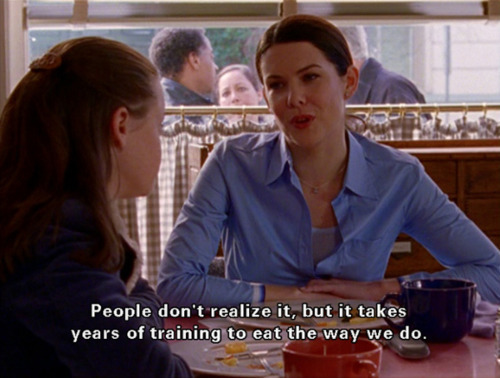
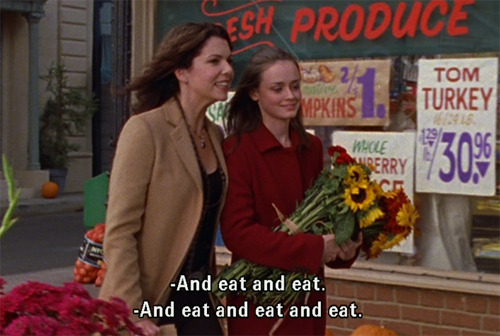
So I ate. A lot. And because I had always been naturally thin, I thought I was invincible and could do so without any physical consequences. I was not and could not, as my Asian relatives were all too quick to point out.
It soon became about proving myself. I wanted to prove to guys that I “wasn’t like other girls” because I knew what guys were saying about girls and it was all negative (this was before I realized how stupid girl hate is and embraced girl love). I also recognized my thin privilege and wanted to prove that I was “just like everyone else,” which is paradoxical, I know. I felt as though I would be villainized if I gave off even the slightest impression that I was actively trying to maintain my thinness. But I was actively thinking about it and struggling with body image issues because I knew that the Cool Girl archetype didn’t work without also being thin and hot.
The idea of the Cool Girl is super damaging because she doesn’t exist. She’s a fantasy constructed by men who want women to relinquish “feminine” behaviors while simultaneously maintaining a hyperfeminine body. It’s really sad that girls grow up into these cultural standards that lead them to believe that they exist to serve men’s expectations and fantasies of them and that they need to separate themselves from “other girls” in the process.
As I grew older, my mindset fluctuated on a spectrum from wanting to be healthy (and whatever body that came with), falling into the Cool Girl trap, and wanting to rebel against the whole system and intentionally being fat and giving myself permission to take up space (which is also unhealthy because I’d be eating junk and gaining weight for no reason). And by this point, emotion-based compulsive binge eating had already become my new normal.
I couldn’t recognize what this was though, for a long time. This had a lot to do with society’s misconception of eating disorders (which Melissa Fabello made a great video about). But it also had to do with our culture’s endorsement of excess, and not just for girls. It’s now considered “cool” to overeat. Self-deprecation is in and the sloth lifestyle is here:

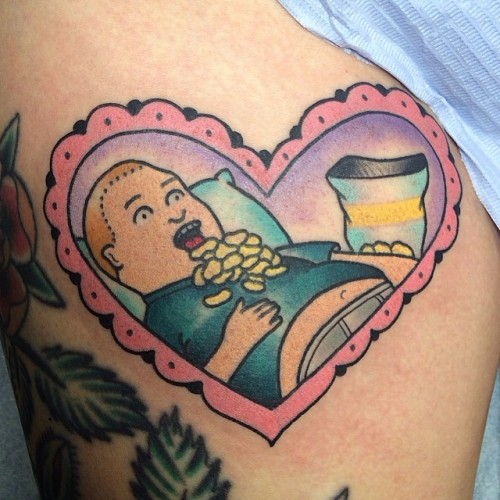
Because it seemed like everyone was doing it, it was hard for me to see the difference between the normal occasional overeating that everyone does, and what I was doing. The glamorization and normalization of unhealthy habits becomes really dangerous because it makes it difficult to then recognize problematic behavior and for those people to seek help.
I’ve been working on establishing a healthier relationship and mentality toward food, body image, and intent. And recovery is definitely a process that looks different for everyone. I still struggle with it every day and am gaining new insights all the time. Like Melissa says in her video, relapse is not failure. It’s not like other addictions where success is measured by the number of days since the last incident. Some days I overcome my eating disorder, and other days I don’t. And that’s okay.

No comments:
Post a Comment