September 20, 2014

Mediocrity Rules, Man.

I graduated from college four weeks ago. And I've been aggressively looking for jobs since. Before graduating I had this idea that I would find a job, any job, nothing career oriented that would take up too much of my mental space so that I could focus on my writing (you know, my ART?) on nights and weekends. And I would slave away doing that. Because that's a romantic notion. I saw myself working at the vegan doughnut shop nearby or maybe as a barista or most probably a receptionist, since I had experience doing that. I also cycled through ideas of trying to freelance full-time or actually looking for a job in a creative field.

After a month of job hunting, I have nothing to show for it but rejections and one offer to transcribe for eight hours a day at this really strange tech outsourcing company. I'm taking the weekend to think it over. The pay is only $10 an hour, which is barely more than I'm making now at the library (my job there expires in a couple months). I also told myself that I wouldn't settle for less than $12 an hour. This is how desperate I've become. The commute is also pretty far. And I can't decide if sitting at a desk typing and very little human interaction all day would be awesome or a nightmare. 

There's something oddly appealing about it though. And I think it stems from the way I tend to romanticize mediocrity/average/low-paying/shitty jobs. I don't know why, but there's something romantic about the hustle. Like working yourself to the bone somehow makes it more fulfilling or worthwhile. It's weird that I think this way because I grew up in a poor/working class family headed by a single mother who worked two jobs. And every since I left home at seventeen, I've never once not worried about money and making rent each month. 

Maybe it's a product of our culture's romanticization of it. When I see cool and beautiful people in movies working low-paying jobs, it always seems appealing. Like, if they'd do it, why wouldn't/couldn't I? And it's strange because since being offered this position, I've teetered between being disappointed because I feel like I could do better, and asking myself why I'm too good for it. 


The shitty, low-paying, no-benefits, dead-end, mind-numbing desk job is like a right of passage, right? 

Maybe I'm not supposed to and it'd unpopular opinion, but every time I watch Ghost World, I romanticize and really identify with Rebecca. I think you're supposed to see her as a boring sell-out yuppie, but there's something nice about the way she seems so together by the end of the movie. So normal. So stable. 


I think that's what I'm craving now. Some stability. Less chaos. I want to be NORMAL. Well, I do and I don't. I have no clue what I'm talking about. 


August 17, 2014

Like Crazy Fashion Vibes

(Outfit 1)
(Outfit 2: Same skirt and tights as Outfit 1)

I'm in the process of moving, which means I'm in the process of feeling pretty letdown with myself for my dirt person consumerist scum habits. So much STUFF! And clothes specifically. I go through periods of experimentation where I try to find my own personal style with a lot of error. I try different trends, am happy for a couple months and then disaffected soon after. Then I say to myself, "I don't need to limit myself to any one style, my style is eclectic! I can look like a young 1960s mother-of-two one day and a punk-goth librarian the next!" So I'd accumulate more clothes because anything goes. And as a frequent and avid thrifter, I fall into the trap of buying anything and everything because it's cheap and feeling over-confident about wearing wacky statement pieces in the store, but never being comfortable and brave enough to actually wear them. 

 (Outfit 3)
(Outfit 4) 
(Outfit 5: Same as Outfit 3)

The idea of minimalist living has appealed to me for a while now. And I've succeeded in certain areas of my life, like reducing my book collection down to about 50 and a very simple hair and makeup routine. What I still struggle with most is home decor knick knacks and clothing. My wardrobe is something I really want to tackle because I will be graduating from college in 3 days (!!!) and moving on to a new stage of my life (perhaps one of young professionalism). And I really just want to get in tune with and really discover what the essence of my personal style is and to simplify my life. I want to stop being paralyzed by choice when I'm getting dressed, and I want to stop spending money I don't have on short-term and emotion-based affairs with clothes. I learned of movements like Project 333 where you choose 33 items from your wardrobe and you can only wear those items for 3 months. There are a number of good videos on YouTube about minimalist wardrobes, but not enough! I really want a lot less items but I want each item to be ones I absolutely love. 

(Outfit 6: Same skirt as Outfit 3 & 5)

Shopping for a minimalist capsule wardrobe is all about the planning. I want to put a lot of thought into identifying what I want my style to be and the key pieces that I'll need so I don't overspend and overbuy things that I won't end up wearing. I want my wardrobe to consist of all of my favorite outfits. After a lot of thinking and search for inspiration, it came to me out of the ether like in a dream: Anna from Like Crazy

(Outfit 7)

Like Crazy is one of my favorite films and I remembered how much I had drooled over Anna and her wardrobe. It was so simple, pretty, and effortlessly chic the way that a lot of European women are. It's a wardrobe that really resonates and feels right for me, and not like I'd be playing dress up in someone else's clothes (which can be fun, too!) So I rewatched the film, this time chronicling (almost) everyone of her outfits. What's perfect about Anna's wardrobe is that it seems to resonate with the minimalist ideal and accurate to real life in that she wears many of the same items over and over, mixing and matching in different ways. You don't always see that in films. And I love that the actress, Felicity Jones, who plays Anna worked with the film's costume designer to shop for Anna's wardrobe and even wore some of her own clothing. 

(Outfit 8)
(Outfit 9)
(Outfit 10)

It was really great and helpful to see Anna's wardrobe evolve so gracefully throughout the film, from college student to young professional while staying true to her personal style. It felt very natural. She mostly keeps it simple with a-line skirts and tops that are easily mixed and matched with flats, and her work wardrobe consists of a lot of basic tops and midi-length skirts and simple dresses. I have so much sweater envy over the grey one she wears. And her very last outfit with the stripes slays me. 

 (Outfit 11: Same pants as Outfit 10 and similar shirt to Outfit 2)
 (Outfit 12)
 (Outfit 13)
(Outfit 14) 
(Outfit 15)

My plan is to be patient and take as long as I need and to check at as many different stores as necessary until I find the perfect piece for each item that I want to have in my wardrobe. And as queen of online shopping, I will try to only shop in stores to make sure that I'm buying clothes that feel good and that fit me well. I'm also going to try to see what I can find at various thrift, vintage and consignment shops first to save money and retain a sense of uniqueness to the items I find before looking at places like Marshalls, Ross, Target and then as a last resort, places like H&M. In one of the videos I watched on minimalist wardrobes, someone said that it's about putting more work into shopping so that you can simplify the process of getting ready in the morning. 

I'm not sure how to end this post. Okay bye. 

August 14, 2014

Acne Survivor's Guilt

image
image

When I was 10, I spent the 20-minute bus ride to school every morning fantasizing about what I would look like when I was 16. I wouldn’t have to wear eclectic outfits thrown together from hand-me-downs and discount retailers, I’d have a boyfriend, and most importantly, I’d be beautiful. What I didn’t account for was acne. And a lot of it. Boys liked me okay, and that felt good, but it was a temporary fix. Because at the end of the day, I felt ugly.

So I spent the 30-minute period of Sustained Silent Reading every day fantasizing about what I would look like when I was 21. I wouldn’t have to wear eclectic outfits thrown together from discount retailers, I’d have a boyfriend, and most importantly, I’d be beautiful.

I am 22 now, and recently did a three-month course of Accutane (a super powerful prescription acne medication with a lot of potential scary side effects). For years I had tried every over-the-counter acne spot treatment, face wash, Proactiv knock-offs, birth control pills, even shelling out $80 on face wash and toner from Sephora. In general I’ve been deliriously happy about how clear my skin has become. But recently I’ve started feeling a little guilty. I recognize that I have for years now benefited from some beauty privilege, fitting into a pocket of society’s narrow definition of conventional beauty as a thin, light-skinned Asian woman with long dark hair. I wasn’t sure how comfortable I was with that. But I knew that my acne was one thing that grounded me and placed me outside the gates of ultimate ~*~conventional beauty~*~. Can you tell that by now I’ve taken a handful of Women’s Studies courses in college?

I wanted to challenge beauty standards, so last December I decided to chop off my long hair. It was finally long enough to cover my boobs, which is a quality of hair I’d coveted since the sixth grade after seeing Christina Aguilera’s Stripped album cover. Culturally, a woman with long hair is seen to be feminine, beautiful, and sexy whereas a woman with short hair may be labeled as either a lesbian or recently dumped. I was tired of playing along. I decided I didn’t want to be pretty. Or at least, not the pretty the media tells me to be. 

Around this same time I had gone off of hormonal birth control pills and was using a non-hormonal IUD. The acne I had suffered from since middle school got WAY worse. I felt really insecure and sometimes I’d look at myself in the mirror and almost cry. Eventually, in a fit of frustration and exhaustion, I told myself that I would own my acne because that was so punk rock. 

This punker acne attitude didn’t last and I was really upset with the way that I looked. But that lead to me being upset about being upset about the way I looked. In the end, I decided to go on Accutane, something I had always casually considered but was too lazy to start the long process. I know compared to others, my acne isn’t horrible or disfiguring. But it was something that I was unhappy with and had been dealing with since I was about 11. At this point, I was 21 (basically a GROWN WOMAN) and exhausted from dealing with acne. I have to give credit to the depth of the conspiracy that the entire adult population could come together and create and maintain the myth that acne goes away once you are no longer a teen.

In the three months that I was on Accutane, I had a slew of side effects. Some normal and just inconvenient and others even more inconvenient and a little worrisome. Things like dry skin, dry lips, dry eyes, dry everything!, nose bleeds, joint pain, bloating, constipation, abnormal menstruation, etc. Not to mention the threat of ulcerative colitis and chronic vaginal and urinary tract infections. But at the end of the three months, my skin was completely clear! And for the first time, I felt comfortable in my skin and that was an incredible feeling. 

Then I started seeing blog posts, YouTube videos, and Lorde and Tavi’s #acnecream selfies where people were accepting their acne and breakouts in a very honest and cheeky way. Right away, I felt inspired: “Yeah, acne! Woohoo!” But then I got a slightly sinking feeling as I realized, oh yeah, my face is clear. I can’t really participate in that anymore. I started feeling guilty, like I had sold out my ideals, put my body through hell, for what, clear skin? I started wondering, Am I silly? Am I vain? Was all this pain I caused my body worth it?  Why do I want to be beautiful? What is beauty? Who am I doing this for? Who cares?

It may seems silly and trivial, but these are the questions I’ve been grappling with. I sort of mourned the loss of my acne. I probably sound like a brat for saying that, but whatever. I mourned the loss of an identity that I had felt was so much a part of me for many years—that of the ugly duckling/weirdo/underdog. And I had felt connected to (even if just in my mind) a group of people who also identified this way. And I wondered if I had betrayed them. Had I become like Kate Sanders who abandoned her best childhood friends Lizzie and Miranda the moment she became pretty and popular? It also felt like a shedding and letting go of adolescence. And maybe I wasn’t ready for that quite yet. 

In the interest of full disclosure, after three of what was supposed to be a five-month treatment, my dermatologist decided it would be best to take a break from the Accutane to see if my more concerning side effects (gastrointestinal and menstrual) would clear up. They did. After an almost two-month break, we discussed if and how we would like to move forward with the treatment. My skin was still clear, but there was no telling if that would last. She told me that patients who don’t finish a full course of Accutane are more likely to see a relapse in their acne. She suggested taking one more month of medication at a very low dose and that we would stop treatment right away if any side effects returned. Almost immediately after returning to Accutane, I had an awful period that lasted nine days, got sick, and a UTI that lasted weeks. I’d had enough. It became clear to me that having a nice complexion was not worth risking my health and the damage it had done to my bank account. I stopped my treatment.

For a while afterward I was extremely paranoid about my acne returning. I’ve had some small pimples here and there, nothing major. This “She’s All That” experience has taught me that it’s okay for me to think I look good. I also think that it’s okay for me to admit to wanting to be pretty. It doesn’t make me a bad person, and it definitely doesn’t make me any less of a feminist. But I think it’s good for me to question and think about these things so I don’t take it for granted and to acknowledge my privilege. I think the best way for me to challenge beauty standards is to set and live up to my own. 

If my acne does come back, I’ll be ready this time. Not with spot treatments and medicinal herbs, but with self-love and perspective. Now I know that the same way pretty doesn’t have to mean long hair, pretty also doesn’t have to mean clear skin. I also know that my friends are wonderful and are not the type of people to place such a great value on a perfect complexion.


“Zits are beauty marks.” –Kurt Cobain 

August 13, 2014

Grinding + "I have a boyfriend" + The Male Ego + Agency


I was thinking about this scene in 500 Days of Summer today and how it’s a great example of a woman exercising her agency to say no to a male’s advances. 

Last week in my Sociology of Sexuality class, we read an article called Grinding on the Dance Floor by Shelly Ronen (who is a badass because she wrote and published this study while she was an undergrad). In it she studies how gendered and sexual scripts are established and followed by males and females through sexualized dancing at college parties. Some of the things she noticed were that the women did not need an invitation to dance, and were normally the first ones out on the dance floor dancing with each other sexily for the pleasure of the men. Men then were the ones to approach the women and initiate “grinding” The woman then accepts or declines. The public sexual act ensues. What’s fascinating is that this entire exchange happens nonverbally. The guy will initiate through eye contact and body language. If a girl accepts his invitation, she begins dancing on him. If not, she will not usually explicitly say no, but will do so in a way that is least embarrassing to him and his male ego. Usually a girl will use her friends, dancing provocatively with them in order to get away from the initiator. This is what she calls “cooling off.” 

When this sexual script is translated to a private bedroom setting between a male and female, it becomes problematic. The male is scripted to be the initiator and the woman is there to be sexy and to accept and comply. What’s dangerous is in this setting she doesn’t have her friends around to save her and she was never taught to or how to say no. 

Another thing. So often when women get unwanted attention from men, they use “I have a boyfriend” as a repellent, whether or not it’s actually true. Why? Well, because it works. And because women are constantly reminded and encouraged to let men done as easily as possible, as to not damage the male ego. A couple problems with this: 1) The fact “I have a boyfriend” works almost all of the time is really sad, because it says that he respects the presence of another man over the woman’s expressed desires. There’s a good article about this here. 2) I REJECT THAT OUT OF HAND. I WILL NOT STROKE THE MALE EGO.

Which brings me to the above scene. What’s so great about this scene is that when Summer get’s hit on by this slimeball, she explicitly and simply says, “No. Thank you.” to his offer to buy her a drink. When he asks if she’s with Tom, she doesn’t respond or acknowledge it. She never claims Tom as her boyfriend. Possibly because they aren’t in an etymological sense, but also because she doesn’t want to stand behind that as an excuse. After persistent aggravation from slimeball, she says, “Hey, don’t be rude. I’m flattered, but I’m not interested. So why don’t you go over there and leave us alone. Thanks.” I get teary-eyed watching this.

I can understand now why she gets so upset with Tom for punching the guy. Because she really doesn’t need him to fight her battles. She’s got it covered.

You Are Enough!


I recently re-watched The Warriors and there was a scene that I found particularly striking. After a long night of fighting for their lives running from cops and every gang in New York City, Mercy (left) and Swan (right) finally find themselves on a subway home to Coney Island. A group of cool teens coming from the prom enter the subway and sit across from them. The discomfort builds as the prom couples exchange looks of pity and disapproval at the huge gash on Swan’s cheek, Mercy’s mussed hair, ripped clothes, and dirty hands and feet. Mercy no doubt feels insecure being so unkempt. She was introduced earlier in the film as a spectacle—something to be seen. Throughout the film she grows to be a sympathetic and complex character, whom Swan refers to as a “tough chick.” Having been the strong, beautiful, sexy woman through most of the film, it is difficult to see her now so insecure and vulnerable. For a moment I think, “If only these lame teens could see how good she looks at her best.” Mercy must think this too, because she reaches to try to fix her hair. But Swan stops both of us. He grabs her hand before she can get there. In that moment, he is screaming “YOU ARE ENOUGH.” 

I love that the makers of this movie allowed our beautiful female lead to be ugly, even for just one scene. Because to assume that a woman is incapable of flaw, and expect that she look perfect at all times (especially after trudging through subway tunnels and engaging in gang war scuffles) is unrealistic, problematic, and insulting.

They Spit On Their Audience

I went to go see a show on Monday that I still have a lot of feelings about it so I thought I’d share them here.

When asked of the best show I’ve ever been to, I usually cite the most recent music act I’ve seen. I was expecting this to be the case Monday night as I headed to the Vera Project in Seattle to see Perfect Pussy, a pro-feminist noise punk band from New York. 

The night started out promising with a two-piece band called Grackles. They had the dynamic of childhood friends who grew up wanting to make out with girls and not, and spending more time coming up with band names, debut album titles, cover art, and liner notes than actually playing, and that Grackles was the name of a Digimon they’d made up. There was a raw sexual energy about them that reminded me of listening to Sex Bob-Omb. The most notable part of their set, for me, was the fact that the drummer drank out of a reusable water bottle. A Klean Kanteen, I think. 

The second act was Eric Padget’s weirdo one man show in place of Future Fridays, who had been scheduled to perform that night but didn’t, for reasons unknown to me. The performance was strange and ineffable, so I will skip trying to write about it here.

When I saw Meredith Graves, lead singer of Perfect Pussy approach the stage, my girl crush was inflamed. I had only discovered Perfect Pussy recently through a friend who was planning to see them at their Portland show (which was cancelled due to Meredith’s complications with her wisdom tooth). During a preliminary internet search of the band, I was really digging their vibe. The articles and reviews I found had nothing but good stuff to say about them. Meredith seemed totally badass and cooler than being cool.

So when I saw Meredith kneeling on stage a few feet in front of me in combat boots, a leather jacket, and a red flower crown talking to two fans, I felt like going up to her and reenacting the scene between Ellen Page and Kristen Wiig in Whip It. I’d be like, “I just wanted to know that you’re my hero.” To which she would say, “Grab a mic, be your own hero.” But I didn’t. And I’m kind of glad.

As they were setting up, the friend I was with commented that it looked like none of them knew each other. I didn’t think anything of it at the time. I also interpreted Meredith sitting on the floor of the stage saying something along the lines of “That’s why I haven’t gotten up, because I knew you guys would break something” to her bandmates as playful rapport.

When they started playing their first song, not only was it physically painful because of the volume, but also extreme discomfort due to the dissonance of not being able to hear Meredith at all. I kind of waited through the first song, thinking that it surely would be resolved by the next song. It wasn’t.

It was unfortunate because when the sound at a noise band’s show is bad, it literally becomes just noise. All the instruments got lost in the bloodcurdling noise. The band members seemed to be lost in general. There was no cohesion in the way that they played. It looked as if each member was just up there doing their own thing without any regard for the others.

What’s worse is that I got the feeling they didn’t give a shit about their audience either. There’s this great scene inFreaks and Geeks where Sam is poking fun of his parents’ taste in music at the breakfast table and his dad eloquently responds by saying, “I guess you’d prefer we listen to that punk rock music I’ve been reading about. You know those Sex Pistols? They spit on their audience! Yep, that’s what I wanna do. Spend my hard earned money to be spit on. Now that’s entertainment…Elvis didn’t expectorate on his fans.”

I felt like Perfect Pussy was spitting on us. And not just because their bassist shot snot rockets that landed unbeknownst on a few audience members. There was no feeling that they wanted to be there. Or that they appreciated that we were there. No rapport with or even acknowledgement of the audience, which may have contributed to the bad vibes I was sensing from the audience, too.

I have never been to a show with so little camaraderie. That feeling of oneness and understanding that we were all there because of the music and our desire to have fun. Going into the show I expected the pit to get rowdy and had planned on joining in. But as the mosh began to break out, I realized that it was near impossible to mosh without any distinguishable beat. But a handful of the audience persevered. At one point, standing outside the mosh, I got knocked down with excessive force and hit the ground. Hard. Slightly pissed and mostly embarrassed, I quickly pulled myself up. I realized in that moment that if that had been any other show I’ve been to, there would have been multiple people helping me up and making sure that I was okay. It was that sense of community I was talking about before, that this audience lacked. It was a very strange feeling.

I felt like I was trapped in a horror show or a David Lynch film. The noise was so loud, and I could see Meredith’s lips moving, but I couldn’t hear a think she was saying. Except for a couple times between songs where she would mumble self-deprecating things like, “Welcome to open mic night. We’ve never rehearsed. Ever.” Fortunately, after twenty minutes, it was over. The band just one by one left the stage without saying anything. It took me a few minutes to realize that their set had ended.

I left that night feeling angry and disappointed. Angry because I had two huge bruises that were beginning to swell from a show that I didn’t even mosh at. Disappointed because I was expecting an inclusive space both from the band and the audience. I’m sure it didn’t affect me as much as it probably did for those fans that had known of and adored Perfect Pussy for much longer than I had. It was painful to watch as they desperately still tried to like and enjoy the set.

This is how I feel. All criticism aside, there were a lot of factors that may have and probably did go into making this night a recipe for disaster. For one, it was at the Vera Project, an all-ages art gallery and music space, which didn’t seem a fitting venue for a band like Perfect Pussy. The second band did not perform as scheduled. Meredith had just gotten over her wisdom tooth complications. The sound was bad. They are tired human beings who have been touring non-stop.

There were definitely a lot of factors that were out of their control. I totally respect them for continuing to play even when the sound was shit. The show went on. But I feel like audiences are generally extremely forgiving if problems are acknowledged gracefully, with humor, and in a way that makes the audience feel appreciated.

I really like Perfect Pussy in theory. And I feel that if we had been able to hear Meredith’s strikingly honest and prophetic lyrics, we could have made sense of that night, why we were all there together, and created an unbreakable bond of invisible strings connecting us together as we all went our separate ways at the end of the night. Perhaps the night fell victim to unfortunate circumstance. I don’t know. If ever they Perfect Pussy returns to Seattle, I’ll go to contrast and compare.

Night of Undesirable Objects

03.19.14

I stood outside the inconspicuous door of an unmarked building, hoping that it was the Heartland. As other weirdos began to congregate near me, I knew we were all here to see Mount Eerie.
(Courtesy of The Heartland)
Inside, the vibes were good and friendly. I quickly became acquainted with a girl wearing a denim jacket that was seriously channeling Jason Segal from the pilot episode of Freaks and Geeks. She remarked on my homemade red dress with cows on it. It was one of those gatherings where you could make friends with absolutely anyone just by commenting on one of their weird articles of clothing. And it always worked because there was always something to be commented on. It was also the type of gathering that sold coffee that was hand-ground and brewed in front of you, served in one of many eclectically thrifted mugs.


(Courtesy of The Heartland)
At 9pm, Erin Jorgenson took the stage and our attention with her command of the marimba and sweet and pretty melodies. She ended her set with a cover of Johnny Thunder’s “You Can’t Put Your Arms Around a Memory.”

When I heard that there would be a cellist on the bill with Mount Eerie, I didn’t know what to expect. All I knew about Lori Goldston was that she had toured with Nirvana. So, that was pretty cool. What happened next shifted something inside of me.

The experience can best be described as weird, which became an apparent and recurring theme throughout the evening. Lori took the stage with percussionist Dan Sasaki. He had a little set up on the floor with a snare drum, a bass drum, a few cymbals, and other miscellaneous things.

They began playing without a word. The performance felt somewhat improvised, and extremely inspired. Lori and Dan’s chemistry is cosmic, vibing off one another without the need of any visual cues. It was a very intense experience to say the least.

It was at times aurally unsettling. Some of the sounds Dan produced made me physically cringe. But the roughness was always grounded by Lori’s deep cello. Dan had an open bag of instruments next to him that he would occasionally pull from, like a serial killer’s murder kit. The music got so spooky at one point, it felt as if we were watching them live score a horror movie, only we were the ones who were going to die.

Their weirdness excited me. Lori paused from playing to take off her scarf without saying anything. Dan tapped on the keys of a typewriter with earnestness and intent. He poured the remnants of a plastic water bottle on his snare drum and sent water droplets flying into the air as he hit it. He stuck his head completely into his shirt and continued to play. He picked up one of his cymbals and used to hit another cymbal like a drum stick. They were classically trained weirdos.

Not everyone “got” it. There was a teen-aged looking guy across the room who kept chuckling as things got progressively stranger. I fucking hated that guy. To me, what Lori and Dan were doing was so weird that it transcended mockery and demanded to be felt.

I found myself both mesmerized and waiting for it to end so I could stop holding my breath. After playing for roughly fifteen consecutive minutes, they paused and Dan let out a heavy sigh, as if he, too, had been holding his breath, signaling for applause before starting again. At the end of their next session, he simply said, “Whoa.”

Their set gave me butterflies—which admittedly could have been a result of drinking coffee on an empty stomach, but I’m going to give credit to the music for dramatic effect.

We were witnessing poetic inspiration on stage. And that inspiration, that madness, was contagious and had caught hold of the audience. This was the very reason Plato condemned poetry. He believed that it propagates passion, a contagion that throws an entire community into collective hysteria. He was right. We were infected. But it wasn’t a bad thing. Sigh. Whoa.

The night of curated weirdness continued as Phil Elverum took the stage in a flannel shirt and unshapely Carhartt pants, accompanied by his keyboard and giant gong. He begins with a few opening remarks: “Hi, thank you all for coming. I hope you’re comfortable. Is there enough room for everyone to sit? I’m asking.” If ever anyone could pull off being both graceful and awkward, Phil can. Everyone sits down in compliance and enjoys Phil’s new (with the exception of one) songs. He comments on their titles, saying, “They all have one word. And nouns.” A few notable ones were “Spring,” “Dragon,” “Pumpkin,” and “Boat.”

Phil’s angelic voice is juxtaposed by a cacophony of feedback and vibrations from his gong. The room laughs as he sings “A bright thing caught my eye. It was a pumpkin. Half,” and becomes pensive during “Looking at garbage, pretending the wind speaks, looking for meaning in songs.” It’s the kind of music that makes you simultaneously want to cry and wish that you were making out with someone.

Kneeling down at the end of his last song, he looks up at us and says thank you. We say thank you back. And in that moment, I swear we were weird.

I know that I can’t put my arm around a memory; I won’t try. But I can write about it.

Thoughts on Cool Girls and Eating Disorders


In the past few months, I’ve come to realize that I had/have an eating disorder after watching fashion blogger Lauren Rose’s video “On Life After Weight Loss.” It prompted me to reflect on my eating habits, which I had never done before in a critical way because I never fit into mainstream media’s description of the privileged white woman who develops an eating disorder and loses control of her life, that either ends in death or her checking herself into a rehabilitation facility. And because I was never problematically overweight. There were a lot of things clouding my ability to see my binge eating disorder.

This post isn’t as much about my eating disorder itself, as it is my own attempt to understand (part of) the root of it. I know that there are cases much more severe than mine, but eating disorders do not discriminate and everyone’s experience is uniquely their own, so I will not belittle my experience by not talking about it.

So I acknowledged that I had/have an eating disorder. I still felt like the same person. My life was not spiraling into a deep, dark abyss. And it didn’t feel like some very scary, “other” thing. Eating disorders are much more complicated than that. And because binge eating disorders are more than the physical act of overeating, things got introspective as I began pondering the psychological manifestations of my disorder.

I recently watched a movie called But I’m a Cheerleader. It’s a satire of homophobia, wherein the main character gets sent to a camp that promises to turn gays straight. The therapy the camp practices is fixated on the camp members discovering their “root” cause for being gay. This prompted hilarious answers like their mother getting married in pants, being born in France, and going to an all-girls boarding school. Obviously, this is a ridiculous and completely wrong way of understanding homosexuality, but I couldn’t help but imagine myself at a fictional group therapy session in a satirical film about eating disorders that does not exist. So, what is my root?

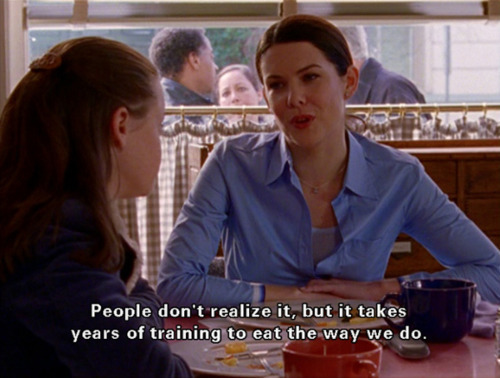
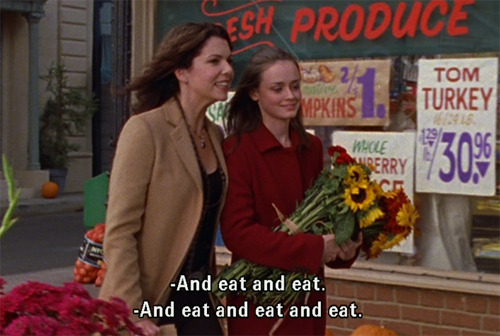
One aspect of my eating disorder is my fear and anxiety around the sensation of being hungry. To me, being hungry is the worst thing that could ever happen to me, like I’ll never be able to eat again, ever. So I’ll preemptively eat and overeat when I’m not hungry in order to never have to experience the feeling of being hungry. I don’t know the exact reasoning behind why I do this, but one theory I came up with was that it had to be some residual anxieties from growing up in a low-income single-parent household. Though plausible and a very socially acceptable root that people can wrap their heads around, I don’t think that it’s the complete truth. It’s more complex than that. So I thought harder and boiled it down to three others: Chad Michael Murray’s game of 20 Questions in A Cinderella Story, Haley Williams eating a cheeseburger, and Gilmore Girls.

I realized that these three things have one essential thing in common, and that is the social construct of The Cool Girl. Buzzfeed recently published an article critiquing Jennifer Lawrence and her Cool Girl-ness and said:

The Cool Girl has many variations: She can have tattoos, she can be into comics, she might be really into climbing or pickling vegetables. She’s always down to party, or do something spontaneous like drive all night to go to a secret concert. Her body, skin, face, and hair all look effortless and natural — the Cool Girl doesn’t even know what an elliptical machine would look like — and wears a uniform of jeans and tank tops, because trying hard isn’t Cool. The Cool Girl has a super-sexy ponytail.

Hazel Cills wrote a response to this piece (she goes on to talk about how damaging it is to critique a woman’s Cool Girl-ness and assume that anything she does is for a man which you should read because it’s great) in which she wrote:

But let’s not forget it’s a construct designed by dudes. A girl is Cool when she does all this shit while simultaneously being hot. Dudes already fetishize beautiful women in circles where they typically don’t exist (ex: metal shows, comic conventions) but simultaneously critique them for being there unauthentically (aka, you’re here to bang dudes!)

In middle school and high school, as a young, impressionable, and insecure girl who wanted to be liked, I really clung onto the notion of The Cool Girl and tried to mold myself into this completely distorted and unfair standard that men held women to. I was just as obsessed with Cool Girls and Manic Pixie Dream Girls as the boys who wanted them. You couldn’t not be with the constant onslaught of MPDGs like the Penny Lanes, Clementines, and Summer Finns and the Cool Girls like Mila Kunis and Olivia Munn. I got the impression very clearly and early on that Cool Girls ate. And ate and ate and ate and ate, and weren’t bogged down by silly things like worrying about their weight. Not giving a shit was Cool. You know, just as long as you were also hot.

The very first incidence of this I can recall is watching A Cinderella Story. Hilary Duff and Chad Michael Murray play romantic interests who go to the same high school, but don’t know who each other are because they met through an online chat room and have only spoken via IM and text under their online monikers. They agree to meet at the school’s masquerade dance. Chad Michael Murray’s character initiates a game of 20 questions in order to figure out who Hilary Duff’s character is. The conversation goes as follows:

CMM: Okay, I got it. Given the choice, would you rather have a rice cake or a Big Mac?

HD: A Big Mac. But what does that matter?

CMM: Well, I Iike a girl with a hearty appetite.

That made a big impression on me. The proverbial seed had been planted. But not as big as the impression of experiencing it for the first time IRL. I was fifteen and at a music festival with my then boyfriend. After Paramore’s set, my boyfriend witnessed Haley Williams scarfing down a huge cheeseburger and commented that it was the hottest thing he’d ever seen. The seed sprouts and only continues to grow more rapidly with exposure to characters like Rory and Lorelai Gilmore, for which their ability to consume massive quantities of heart disease-inducing food and remain devastatingly thin and beautiful is in-text meant to be repulsive, but in subtext seductive.


So I ate. A lot. And because I had always been naturally thin, I thought I was invincible and could do so without any physical consequences. I was not and could not, as my Asian relatives were all too quick to point out.

It soon became about proving myself. I wanted to prove to guys that I “wasn’t like other girls” because I knew what guys were saying about girls and it was all negative (this was before I realized how stupid girl hate is and embraced girl love). I also recognized my thin privilege and wanted to prove that I was “just like everyone else,” which is paradoxical, I know. I felt as though I would be villainized if I gave off even the slightest impression that I was actively trying to maintain my thinness. But I was actively thinking about it and struggling with body image issues because I knew that the Cool Girl archetype didn’t work without also being thin and hot.

The idea of the Cool Girl is super damaging because she doesn’t exist. She’s a fantasy constructed by men who want women to relinquish “feminine” behaviors while simultaneously maintaining a hyperfeminine body. It’s really sad that girls grow up into these cultural standards that lead them to believe that they exist to serve men’s expectations and fantasies of them and that they need to separate themselves from “other girls” in the process.

As I grew older, my mindset fluctuated on a spectrum from wanting to be healthy (and whatever body that came with), falling into the Cool Girl trap, and wanting to rebel against the whole system and intentionally being fat and giving myself permission to take up space (which is also unhealthy because I’d be eating junk and gaining weight for no reason). And by this point, emotion-based compulsive binge eating had already become my new normal.

I couldn’t recognize what this was though, for a long time. This had a lot to do with society’s misconception of eating disorders (which Melissa Fabello made a great video about). But it also had to do with our culture’s endorsement of excess, and not just for girls. It’s now considered “cool” to overeat. Self-deprecation is in and the sloth lifestyle is here:


Because it seemed like everyone was doing it, it was hard for me to see the difference between the normal occasional overeating that everyone does, and what I was doing. The glamorization and normalization of unhealthy habits becomes really dangerous because it makes it difficult to then recognize problematic behavior and for those people to seek help.

I’ve been working on establishing a healthier relationship and mentality toward food, body image, and intent. And recovery is definitely a process that looks different for everyone. I still struggle with it every day and am gaining new insights all the time. Like Melissa says in her video, relapse is not failure. It’s not like other addictions where success is measured by the number of days since the last incident. Some days I overcome my eating disorder, and other days I don’t. And that’s okay.